Professional tennis pays for matches played and books a zero against your ranking for the ones you miss — and at Grand Slam level it will not forgive that zero for an injury. This is what the evidence says that does to bodies, and what a league with a fixed season, a substitution rule and a salary can and cannot change about it.
Ten sections, sourced at every claim · about eight minutes
54%Of injury-affected days in a professional season, days the player kept going
61%Injuries presenting at Wimbledon that were not new
~150The ranking at which a professional with a coach breaks even
12 wksThe shortest evidence-based course for a tendon
0Published studies of what an injury costs a tennis player
■ Where this starts
Three weeks ago, the physician on our own medical partnership said this to a wire service.
“We’re losing the battle overall despite the advances in sports
medicine.”
Dr Neeru Jayanthi, Director of the Tennis Medicine Program, Emory Healthcare
· to AFP, 31 August 2026
Emory Sports Medicine is INTENNSE’s healthcare provider, and Jayanthi is
the physician named in that partnership. He is also one of the people who writes this
literature: forty-plus indexed papers, co-author of the American Medical Society for Sports
Medicine and AOSSM consensus statements on early specialisation, and a co-author of the study
that remains the best evidence in tennis that a governing body can lengthen careers by changing
its own rules.
Otis, Hainline, Jayanthi, Stroia et al., British Journal of Sports
Medicine 2022 (PMID 35396204): after the WTA introduced its Age Eligibility Rule and Player
Development Programme in 1995, median career duration went from 12.1 years to 14.2. Across 811
players over 25 years.
■ The part that argues against us
Tennis is a low-injury sport, and any page that pretends otherwise deserves to lose.
On the NCAA’s surveillance system, which applies one definition across
every sport, tennis sits near the bottom: 4.89 injuries per 1,000 athlete-exposures for
men and 4.88 for women, against 5.30 for men’s basketball, 7.29 for football and
9.28 for wrestling. Per hour of play, elite rugby union runs roughly thirty times higher.
Tennis appears in none of the high-injury groups at Rio or Tokyo.
Nor is there a clean case that injuries are rising. Across 46 years of ATP and
44 of WTA match data, mid-match retirements rose about 50% on the men’s tour from 2006 to
2014 and then returned to pre-2006 levels from 2015. On the women’s tour
they did not come back down. The ATP’s own surveillance showed 1–3% year-over-year
variation from 2014 to 2017. Fifty years of WTA walkover data shows a rise its authors call
“slight.”
What is not established
That tennis is dangerous. That injuries are
broadly increasing. That the sport is more punishing than the ones it competes with for
attention.
Better medical provision and better recording explain part of what looks like
a rise — the Australian Open study that found a genuine increase defines an injury as a
consultation with a tournament physician, and reports consultations rising in the same
window.
What is established
That stress fractures and upper-arm injuries at the
Australian Open rose more than twofold over 2011–2016, on Tennis Australia’s own
data.
That cumulative competition load causally increases time lost — hazard ratio
1.05 per additional 1,000 games, across 389 players and 55,773 competition weeks, magnified
with age. Naive analysis of the same data gets the sign backwards and shows load as
protective.
Lynall et al., BJSM 2016 (PMID 26719502); Williams et al. 2022 (PMID
34854059); Oliver et al., Eur J Sport Sci 2024 (PMID 39308146, open access); Fu et al.
2018 (PMC5825333), reporting unpublished ATP surveillance; Peña et al., Sports Health
2026 (PMID 41272923); Gescheit et al., BJSM 2017 (PMID 28687543); Kovalchik, PLoS
One 2020 (PMID 32302343, open access).
■ The number underneath it
More than half of a professional season’s injury days are days the player carries
on.
The Lawn Tennis Association’s physiotherapy department tracked 33
supported professionals through every day of 2023. One hundred and nine injuries, and
2,115 days affected by them — of which 972 were days lost and 1,143 were days
modified. The player was still there, doing less.
It is sharpest exactly where the sport is said to be breaking down.
Seventy-one per cent of shoulder-affected days were modified rather than
lost. Elbow, seventy-eight. Hand, a hundred. On any given day, about one player in six was
carrying something.
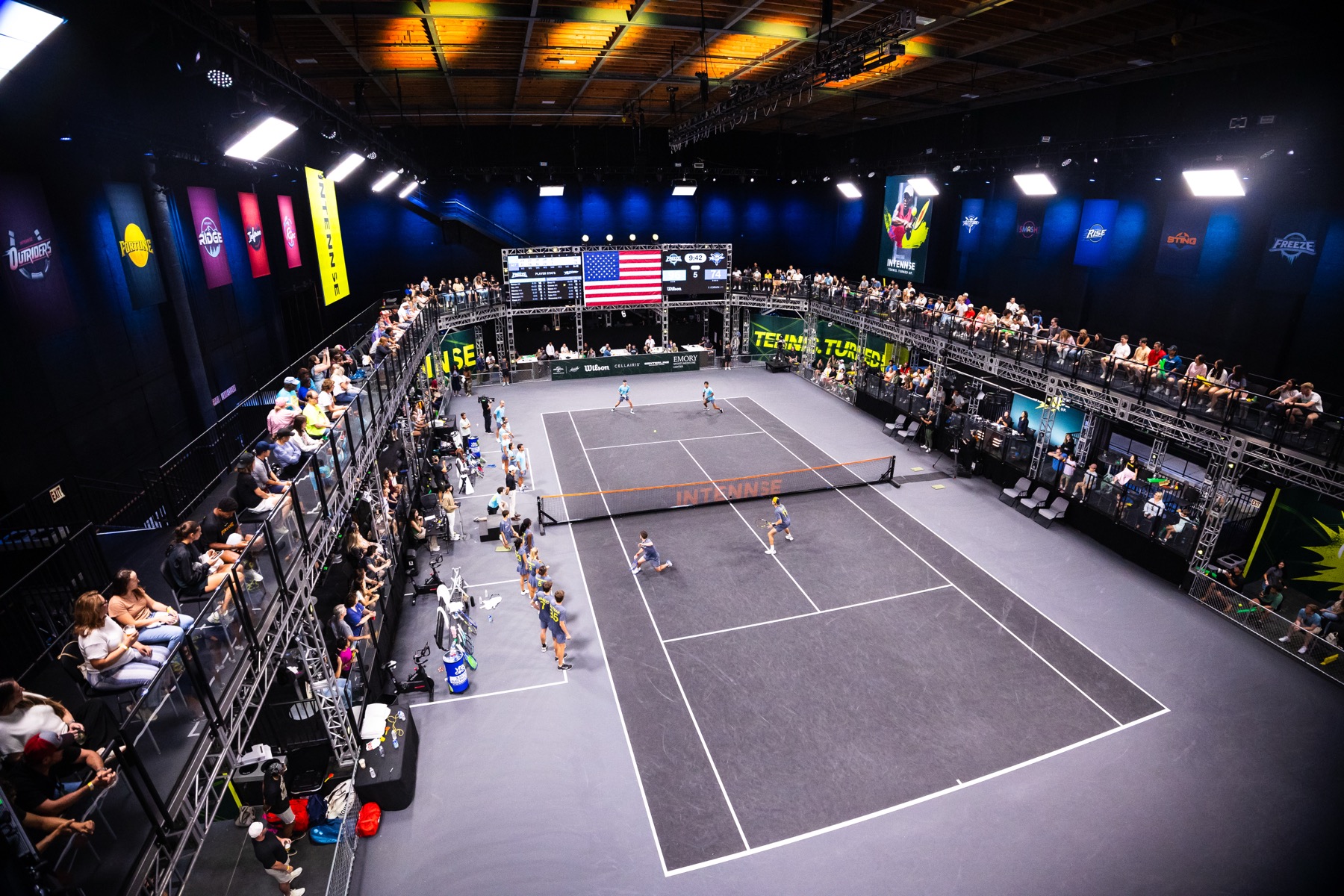
INTENNSE Arena, Atlanta
Nutt, McCaig & Cooper, International Journal of Sports Physical
Therapy 2025;20(12):1752–1762 (PMC12673947). Lead author with the LTA Physiotherapy
Department, National Tennis Centre. The paper defines “modified” against training
rather than match play, so it evidences continued participation rather than measuring competing
hurt directly. Thirty-three players, one nation, one year.
Two other findings say the same thing from different
directions. At Wimbledon over 2007–2012, only 39% of the injuries presenting to
the medical team had arisen during the tournament — 34% were sustained elsewhere
before arriving, 16% were pre-existing chronic problems, and 11% were recurrences within eight
weeks of recovering from the same injury at the same site. And the sport’s own medical
establishment has put it in a consensus statement.
“Such a broad definition is crucial for tennis, a sport where non-time-loss
problems dominate the injury and illness spectrum.”
ITF/IOC tennis consensus statement, BJSM 2021;55:9–13
· co-authored by the heads of sports medicine of the ATP and the WTA
McCurdie et al., BJSM 2017;51:607–611 (PMID 26755678, open
access), 700 presentations across 33,790 player-sets. Verhagen, Clarsen, Ellenbecker (ATP),
Hainline, Reid, Stroia (WTA), Pluim et al. (PMID 33082146, open access).
■ What the rulebooks price
The sport pays for matches played, and books the zero either way.
A player who is hurt has three options, and the rules put a price on all
three.
Play, and lose. Prize money arrives. “Prize money shall be paid only for
matches played” — Grand Slam Rule Book J.1, and ATP Rulebook §3, and ITF
World Tennis Tour Regulations XII.B, in nearly identical words.
Withdraw before the first match. At a Grand Slam that pays 50% of first-round money
— but only if the tournament doctor declares the player unfit, only twice a calendar
year, and only if the player competed in a tournament in the preceding 21 days.
A player who has been off injured for a month qualifies for nothing.
Miss the event. The ranking takes a zero regardless. ATP §9.03: the result
“shall count for his ranking, whether or not he participates.” WTA
§II.A: a zero “which must count on her WTA Singles Ranking.” Relief on the ATP
requires missing two or more consecutive mandatory events, and the sanctioned
cure for a withdrawal is to enter another tournament. On both tours the Grand Slam
zero cannot be relieved by injury at all.
The safety net has also been narrowed, and the change
is traceable across five editions of one rulebook. In the 2019 Grand Slam Rule Book there was no
recent-competition requirement. The 2021 edition added one, scoped to “players who have
been out of competition for 30 days or more.” By 2023 that qualifier had been
removed and the 21-day condition applied to everyone.
Protected and Special Rankings restore entry to a draw. They restore no ranking
points, no prize money, and on the ATP no seeding — the rulebook says so twice, in two
chapters. The WTA does grant a returning player an additional seed, but never at a Grand Slam.
And Section G of the Grand Slam Rule Book lets a referee fine a player up to their
entire first-round cheque for not competing to the required professional
standard — listing among its factors that the player did not compete in the preceding three
weeks, that they retired from their last tournament, and that they entered on a protected
ranking.
ATP 2026 Official Rulebook §9.03 and §F; 2026 WTA Official Rulebook
(rev. 27 July 2026) §II.A and §VIII.C; Grand Slam Rule Book §J.1 and §G,
2019, 2021, 2023 and 2026 editions; ITF World Tennis Tour Regulations 2024 §XII.
■ Who this bites
One lost match is worth $140,000 at one end of the sport and $156 at the other.
A first-round loser at the 2026 US Open took $140,000 from
a record $108m purse. The same result at a Masters 1000 paid $24,335. At an ITF M15 it paid
$156, and zero ranking points. A spread of roughly nine hundred times, on
the same outcome.
So the squeeze is not evenly distributed, and a page that says the sport
does not pay injured players will be corrected in one sentence. What holds is narrower: the
money is for starting the match, and it thins to nothing below the top.
The newest peer-reviewed estimate puts break-even — costs including a
support team against prize money — at a corridor around ranking 150,
with only 32–34% of former top juniors finishing their careers financially positive.
The figure usually quoted, 336 for men and 253 for women, is from 2013 and its own slide
heading says it excludes support-team costs altogether.
Season 2, Atlanta
Schöttl, Keiner, Metz & Kainz, Social Sciences & Humanities
Open, 29 June 2026 (DOI 10.1016/j.ssaho.2026.102986, open access). ITF Pro Circuit Review
— Stage One, December 2014, on 2013 data; the slide producing 336/253 is headed “what
are the breakeven ranks… without support team costs,” and the 2018
Independent Review of Integrity in Tennis concedes at ¶84 that “the real break even
point is likely at a higher ranking than these figures suggest.” Prize money from
atptour.com 2026 tables and ITF World Tennis Tour Regulations 2024, Appendices H and J.
Prize-money inequality in tennis is more extreme than
in any other major sport — a Gini coefficient of 0.87 for women and 0.68 for
men. And the counter-argument deserves its own line: the ATP’s Baseline programme
does guarantee a floor. In 2025 it paid $2 million across 30 players, against a
$108m US Open purse, to men only. Its injury-protection pillar reached three players in 2024.
Every player on an INTENNSE roster sits on the wrong side of that line. Open
Our players and the tour below and the orange rule is the break-even ranking: of the 25
ranked men on our rosters and the 20 ranked women, all 45 are outside it.
Grove, Jetter & Papps, Journal of Economic Behavior &
Organization 2021;183:362–376. ATP releases of 22 August 2023 and 18 December 2024. No
WTA equivalent to Baseline could be verified.
A gender-balanced Professional Team Tennis League
Eight playing weeks in the middle of the summer. Switch the view to see the
same season against the American sports year, or against the college calendar our players come from.
INTENNSE Grand Slams Team events
INTENNSE Regular season Postseason
INTENNSE Regular season Postseason & championships
2026 season. INTENNSE: 5 June – 1 August, 58 days, one dark week for Wimbledon. Sources: data.intennse.com/2026/calendar.tsv; published tournament calendars.2026 calendar year. The NBA and NHL finished on 13 and 14 June; the NFL’s season opens 9 September; LOVB ran January to April. Only MLB is in season through INTENNSE’s eight weeks. Sources: published league calendars; INTENNSE figures from data.intennse.com.NCAA Division I, 2026 as it happened. Both the men’s and the women’s team championships finished on Sunday 17 May at the Dan Magill Tennis Complex in Athens, Georgia — Virginia over Texas, Texas A&M over Auburn. The NCAA has moved singles and doubles out of May: they are now a November event, so a graduating senior has nothing left on the college calendar at all. Basketball’s season opened in November 2025; the January football block is the 2025 season’s playoff. D-I carries 5,207 tennis players across 541 programmes. Sources: ncaa.com championship releases, official school schedules, NCAA Sports Sponsorship and Participation Rates Report 2024–25.
Where our players have been on the tour, and where they sit on the rating that
covers everyone. The orange rule is where tennis starts paying for itself.
Career high September 2026MVP race ↗ (second scale) alone = no tour ranking, placed by MVP standingName in yellow = straight from college
Rounds 1–3 of the 2026 draft, plus three players the draft board leaves out altogether and one fourth-round pick: 56 in all. Forty-seven carry an ATP or WTA career high. The nine below the dotted line in each panel have no tour ranking on record and are placed by where they finished in the league’s own MVP race — among them Sofia Cabezas, fifth in that race, and Corey Craig, thirteenth, straight out of Florida State. Two more carry a career high but no current singles ranking, so they show a career-high dot alone. Fourth-round picks are otherwise excluded — 2027 rosters are three women and three men. The one exception is John Chin, 19th of 31 men over four Arcs, ahead of eight higher picks including two first-rounders. A player placed by MVP standing needs more than one Arc behind the number: Season Score is the sum of a player’s best six rounds divided by six, so a single appearance is not a season. Ranking axis runs worst to best, left to right, as in the UTR chart below. The MVP race is a separate scale, and it stops at our own best-ranked player rather than running the width of the chart — it ranks these players against each other inside the league, not against the tour. Aliona Bolsova sits inside that line on both counts: a career high of 88, inside a Grand Slam draw, and first in the 2026 MVP race. A career high is never drawn worse than the player’s current ranking: where a recorded best is stale, the best is at least today’s rank and the two collapse to a single point. Tier cut-offs: main draw top 128 — the draw size of a Grand Slam — Challenger 129–350, ITF Futures 351–900 (the ITF renamed the Futures circuit the World Tennis Tour in 2019). The orange rule is the break-even ranking — where prize money covers the cost of competing. It is drawn at ~150, which is where a peer-reviewed 2026 study puts it once a realistic cost base including a coach is counted — and every professional has a coach. The faint rule behind it is the ITF’s own 2013 figure, 336 for men and 253 for women, which sits at a worse ranking only because those costs exclude coaching and all support-team expense. It is the bar nobody actually competes under. Against the real bar: of the 26 men here with a career high, all 26 never reached 150; of 21 women, 19 never did — the exceptions are Aliona Bolsova at 88 and Usue Arconada at 130. On today’s rankings it is unanimous: 25 of 25 ranked men and 20 of 20 ranked women sit outside break-even. Sources: draft.intennse.com, stats.intennse.com MVP race, intennse.com player pages, Tennis Abstract, retrieved 20–21 September 2026; ITF Pro Circuit Review, Stage One: Data Analysis, December 2014; Schöttl et al., Social Sciences & Humanities Open, 29 June 2026.
UTR: our players against the tour’s
INTENNSE player Straight from collegeTop three picks per team Tour band (10th–90th percentile)
Bands derived from 286 players who publish both a UTR rating and an ATP/WTA ranking, taken at the 10th–90th percentile of each tier. INTENNSE ratings: the top three men and three women per 2026 roster — 28 men and 30 women carry a rating on the league’s own draft board. Source: draft.intennse.com players board, retrieved 20 September 2026.
Down to the wire; Sudden Death
Two Arcs that finished a point apart. Each clip picks up in the closing minutes,
with the full Arc a click away.
Sudden death, level at 142
The final three minutes of Freeze v Rise, 20 June. The clock runs out with the teams tied, and the next point decides it: 143–142.
The treatments that work are measured in weeks off, and the evidence on shortcuts is not
ambiguous.
The foundational tendon trials all run twelve weeks, and the protocol that works
opens with six weeks of no sport at all. The trials on shortcutting it say the same thing three
times over.
Tennis elbow, one year outCorticosteroid injection: 83% recovered, 54%
recurrence. Placebo: 96% recovered, 12% recurrence. The injection wins at six weeks and loses
at twelve months.Coombes, JAMA 2013, n=165
The same reversal againAt six weeks injection beat physiotherapy 92% to 47%.
At fifty-two weeks the order inverted: physiotherapy 91%, injection 69%.Smidt,
Lancet 2002
Navicular stress fracture86% returned to sport after six weeks
non‑weight‑bearing. 26% returned among those who kept loading with limited
activity.Khan, AJSM 1992, 86 CT-proven cases
What the big repairs costRotator cuff in overhead athletes: 75% return, mean
6.4 months, one in four never returns. Hip arthroscopy in professionals: ~85% return at a
median 7.5 months, and 25–57% after a revision.Migliorini 2023; Uppstrom
2026
Set those weeks against the rulebook in the section
above. Twelve weeks of tendon rehabilitation is roughly three mandatory events. Six weeks
non-weight-bearing is a ranking a player will not get back inside a year. Nothing in either tour’s
rules is written in the units the body uses.
Jonsson & Alfredson, BJSM 2005 (PMID 16244196): “All patients
ceased sporting activities for the first 6 weeks.” Coombes et al., JAMA
2013;309(5):461–9 (PMID 23385272); Smidt et al., Lancet 2002;359:657–62
(PMID 11879861); Khan et al., AJSM 1992 (PMID 1456359); Migliorini 2023 (PMID
36656423); Uppstrom 2026 (PMID 42077177).
■ On the record
The players describe the mechanism themselves, and one of them describes the format.
“Financially, there might be people that don’t have that luxury to stop a week
out of their schedule and not play — the majority of us are still trying to make a
living. I’ve played through many injuries, I’ve also stopped through many
injuries.”
Katie Boulter, British No. 3 · BBC Sport, 6 May 2026
“I’m skipping a couple of events in order to protect my body because I struggled
a lot last season… This season we will try to manage it a little bit better,
even though they are going to fine me by the end.”
Aryna Sabalenka · Brisbane, 8 January 2026
Sabalenka’s sentence sits directly on the rulebook: she is describing
§II.A while doing the medically correct thing. Denis Shapovalov, who had played Wimbledon
with a fractured rib: “it’s going to take a couple more big guys getting hurt for
the people to step in and make a change.” And in a federal complaint filed in the
Southern District of New York, a named professional of thirteen years states the causal claim
outright — that he has repeatedly played when not physically capable “because of the
negative repercussions his career would face if he passed up the opportunity to earn prize money
and Ranking Points.”
The line that describes what a team format actually changes came from a
commentator watching the injury wave at Wimbledon:
“It’s so tough playing an individual sport. You can’t be subbed
out, you just have to be dunked back in the deep end immediately.”
Naomi Broady · BBC, 29 June 2026
Pospisil v. ATP Tour, Inc., No. 1:25-cv-02207-MMG (S.D.N.Y.), Complaint
¶192, on named plaintiff John-Patrick Smith — an allegation in a counsel-drafted
pleading rather than a spoken quote. No merits ruling has issued. The claims made by the
Professional Tennis Players Association about rising arm injuries are not cited anywhere on this
page: no methodology, denominator or data has been published, and the association is a litigant
against the tours.
■ One season, one player
Sophie Chang played five tournaments on a fractured rib, then came to us on three
injections.
Chang reached 217 in singles and 59 in doubles, won the Hamburg title in
2022 and made the third round of the US Open doubles in 2023. She left the tour after
Charleston, on a protected ranking. In September she told the Yips & Giggles
podcast what had happened, at length and without being asked to make it flattering.
On the rib: “I remember the day it started hurting… But the
thing was then I played like five tournaments after that, like on it.” The MRI
turned a possible recovery into a two-month one. Then, before our season: severe inflammation
in the right hip and a disc protrusion.
A Friday night in Atlanta
“I ended up getting several injections into my hip and into my spine to be able to
play INTENNSE, because I was starting to get really excited about playing that. I was like,
this is something that I’ve wanted to do my whole career and I am not missing
it… I flew home mid-season to get my third shot.”
Sophie Chang · Yips & Giggles, Ep. 23, 8 September 2026
She arrived not having played a singles point in a year. What the season gave
her was room to manage it:
She sat out a match and came back for the next one. “My back in the first
month was kind of getting worse each match… So I sat out of the third match and then
came in for the fourth again, and then I got my third injection and actually felt pretty good
throughout the rest of the season.” Under tour rules there is no such thing as sitting
out the third match.
A week between matches instead of consecutive days. “Let’s say I played
that first match and I had a week to like, okay, I’m going to hit some returns. It
wasn’t like, oh, I got to go out tomorrow and do the same thing.”
A coach on site. On the tour: “if I had a really terrible match, I
didn’t have a coach with me or any hitting partner or anything.”
Pay that did not depend on the result. “I actually get paid to just show up,
you know, and like win or lose, you know what I’m getting.” Against the tour,
where “usually means like you lose, you’re at a negative.”
And then the part that matters most, because it is the
part a recovery story would leave out. She is not healed.
“I was able to make it through the season. But my plans after — like, I need to
let it heal. It still does bug me sometimes and it’s not healed. Like, I got that to
be able to play the season.”
Sophie Chang · same episode
She also names something the league costs her. A protected ranking is suspended
only while a player is out of everything, and paid play restarts the clock — on the ATP
side the rulebook is explicit that it runs from “the first tennis event, including Special
Events – Exhibitions, that the player competes in.” In her words: “it
actually comes unsuspended as soon as you’re playing, even in a league like
INTENNSE.” Playing for us started her twelve months. That is a real cost and it belongs
on the page next to everything else.
What she said about the competition itself: “Leaving the event I was
like, that was the most fun I’ve ever had just in the essence of competition… it did
make me want to explore being an athlete, a competitive athlete again.” In the year
before, off tour, she had not missed competing at all.
Quotes verified against the episode’s caption track. Chang gives her last
tour event as the Charleston Open; public records list a January 2025 event in Rome, Georgia.
■ What the format changes
A fixed season, a home city, a roster and a salary.
None of this makes tennis safer to play. It changes what a player has to give up
to look after a body, which is a different claim and a smaller one.
Unlimited substitutionThree women and three men on one cumulative score, with
a bench. A player who should not be on court comes off, and the team keeps
playing.Broady’s point, answered
Eight weeks, then it stops5 June to 1 August. The tour runs 52 weeks and a
player can enter something every one of them.A real off-season
One cityNo time zones between matches. For every hour of time-zone difference
travelled, WTA players slept 11 minutes less on the first night — measured by the
WTA’s own sports-science department.Maynard et al., Sports Health 2026
Salaried, on a rosterEmployees on a base wage with league coaching. Pay does
not turn on starting a match, so declining to start one costs nothing.W2, not
entrants
Medical on site all seasonEmory Sports Medicine provides on-site athletic
training and medical support throughout the season for all players, plus year-round
care.Per the 12 June 2025 partnership
A week between matchesRather than consecutive days, then the next tournament.
It is the difference between treating something and playing around
it.Chang’s description
What it does not change: the ranking a player is on
leave from, the clock that starts when they take paid competition, and the tour they may want to
go back to. A league cannot rewrite either tour’s rulebook. It can be the place where
playing does not cost more than it pays.
■ Where the evidence stops
The things this page will not claim.
That injuries in tennis are rising. The men’s retirement rate went up and came
back down. Specific categories at the Australian Open rose more than twofold; the general claim
does not hold.
Any figure from the PTPA. The “arm injuries up 112%” number exists only
in a graphic attached to a post on X, with no denominator, sample size or method published.
That imaging shows a damaged population. It would show that whether or not anyone
hurt: 64% of asymptomatic elite juniors have a lumbar abnormality.
That continuity of medical staff improves outcomes. Intuitive, and untested —
no study in any sport tests it directly.
A number for how many professionals compete injured. No survey or study measures it.
The LTA surveillance above is the closest thing that exists.
That players were healed here. One finished a season she could not otherwise have
played, and says on the record that the injury remains.
One absence is worth stating on its own. Searching the
economics literature turns up work on gender pay gaps, on prize-money skew, on the effect of
technology — and nothing at all on what an injury costs a professional tennis
player. The sport has never measured the thing this page is about.